

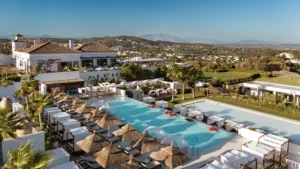


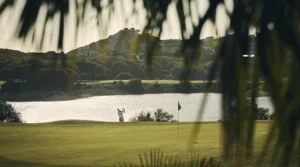


In the heart of Sotogrande, within The Seven, Villa Nara emerges as a proposal that goes beyond architecture understood as an object. Designed by ARK Architects, the residence offers a deeper reflection: how space influences physical and mental wellbeing, and how architecture can become a vehicle for a more balanced life.
We spoke with Manolo Ruiz, architect of the project, about the origins of Nara, its relationship with the landscape, and the idea of longevity as the central axis of the design.
Nara is presented as a home closely linked to experience. What was the starting point of the project?
Nara is a house designed for the senses. From the moment you enter, the home transports you into a state of calm and relaxation. The project was born with a very clear intention: to respect the DNA of the place. What makes it special is precisely its integration with the surroundings, its ability to blend seamlessly into the landscape.
Nara is a house designed for the senses. From the moment you enter, the home transports you into a state of calm and relaxation. The project was born with a very clear intention: to respect the DNA of the place. What makes it special is precisely its integration with the surroundings, its ability to blend seamlessly into the landscape.
That relationship with the environment seems key to the project. How is it translated architecturally?
The intention is almost to not exist, to give all the prominence to the site itself. We are on an exceptional plot within Sotogrande, with views of the Mediterranean and the Guadiaro Valley. It had to be respected. The project is broken down into volumes that adapt to the topography, as if they had always been there.
The intention is almost to not exist, to give all the prominence to the site itself. We are on an exceptional plot within Sotogrande, with views of the Mediterranean and the Guadiaro Valley. It had to be respected. The project is broken down into volumes that adapt to the topography, as if they had always been there.
One concept that appears repeatedly is longevity. How is it integrated into the architecture?
Longevity, understood through the care of body and mind, is fundamental. Today we know — and science confirms — that living in connection with nature has a direct impact on our emotional and cognitive systems. Architecture can help us reconnect with that state.
Longevity, understood through the care of body and mind, is fundamental. Today we know — and science confirms — that living in connection with nature has a direct impact on our emotional and cognitive systems. Architecture can help us reconnect with that state.
Nara is conceived to generate that feeling through space itself, not only through technology. Speaking of which, what role does wellness play in the home?
Wellness is not an add-on; it is part of the project. Of course, the house incorporates cutting-edge technology — spa areas, advanced systems, high-end equipment — but what truly matters is how the architecture guides you towards that state of wellbeing. It is the dialogue between the natural and the built environment that genuinely creates the experience.
Wellness is not an add-on; it is part of the project. Of course, the house incorporates cutting-edge technology — spa areas, advanced systems, high-end equipment — but what truly matters is how the architecture guides you towards that state of wellbeing. It is the dialogue between the natural and the built environment that genuinely creates the experience.
In that sense, there is a strong presence of cultural, even Eastern, references. Where does that inspiration come from?
Nara is a project that moves between East and West. Both Zen Buddhism and Shintoism place nature at the centre of their philosophy, and that resonates deeply with our way of understanding architecture. The name is a tribute to that culture, but also to that way of perceiving space.
Nara is a project that moves between East and West. Both Zen Buddhism and Shintoism place nature at the centre of their philosophy, and that resonates deeply with our way of understanding architecture. The name is a tribute to that culture, but also to that way of perceiving space.
Materiality, courtyards, water… many elements seem to build that relationship with nature.
Yes, because it is not about imitating nature, but about engaging in dialogue with it. We use natural materials — stone, wood, metals — and elements such as courtyards that bring nature into the interior. The courtyard also has a bioclimatic function: it allows the house to breathe naturally. Everything is designed to create balance.
Yes, because it is not about imitating nature, but about engaging in dialogue with it. We use natural materials — stone, wood, metals — and elements such as courtyards that bring nature into the interior. The courtyard also has a bioclimatic function: it allows the house to breathe naturally. Everything is designed to create balance.
What role does Sotogrande play in all of this?
Sotogrande has something truly unique. There is a powerful natural value embedded in its DNA. When someone arrives here, they already enter an environment that predisposes them to wellbeing. It is almost a natural sanctuary. What Nara does is amplify that quality.
Sotogrande has something truly unique. There is a powerful natural value embedded in its DNA. When someone arrives here, they already enter an environment that predisposes them to wellbeing. It is almost a natural sanctuary. What Nara does is amplify that quality.
If you had to summarise the project in one idea, what would it be?
If we are able to design a home that reads the place and elevates it to another level, we are creating more than a house. We are creating a sanctuary for life.
If we are able to design a home that reads the place and elevates it to another level, we are creating more than a house. We are creating a sanctuary for life.